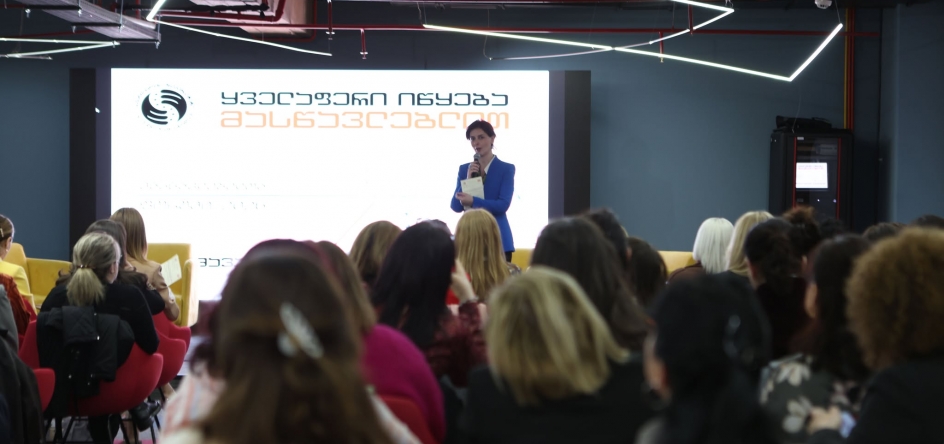
On April 4, the University of Georgia hosted the first event of its strategic project “University of Georgia for Teachers” — a teachers’ forum titled “Transitional Stages in Education,” which included:
The teachers’ forum was held within the framework of a new, large-scale initiative by the University of Georgia, which consists of several phases and involves teachers from all levels across Georgia. The project aims to support teachers, strengthen their professional role, and develop partnerships between universities and schools. It holistically presents the educational ecosystem and the connections between its stages: student – teacher – school – university.
“I believe it is very important that such a large-scale project is led by a university, and most importantly, it is not limited to teachers selected by segment classification. I mean that teachers from all levels are involved in the project. It is also noteworthy that the workshops were very well selected; with their help, an educational chain was formed from kindergarten to university. Most importantly, this is not a one-time project, which allows teachers to participate in future activities,” Natia Uchava - mentor teacher and recipient of the National Teacher Award.
It is worth noting that during the teachers’ forum, the concept of the project’s concluding event — the “Teacher Impact Award” — was announced. This award will recognize a teacher selected by a special jury based on competition criteria. The winner will be the teacher whose outstanding initiatives and projects have a significant positive impact on students and the learning process.
Teachers from all over Georgia attended the forum held at the University of Georgia. Notably, the project brought together educators from all levels (basic, secondary, and upper secondary). Invited teachers had the opportunity to attend training sessions both in purely academic fields and on social and psychological transformations that accompany each stage in education.
“In our workshop, where we discussed the use of AI tools, we thoroughly examined the challenges that begin as early as kindergarten age. We discussed what kind of foundation students bring to first grade, how involved parents should be from the preschool stage, and what competencies students have when they reach university. We also reviewed international experiences and the connecting links that, in harmony, create a high-quality educational process,” Dimitri Popov, workshop facilitator; expert in computer and engineering technologies; educational technology coach; expert in computer technologies at the National Center for Educational Quality Enhancement.