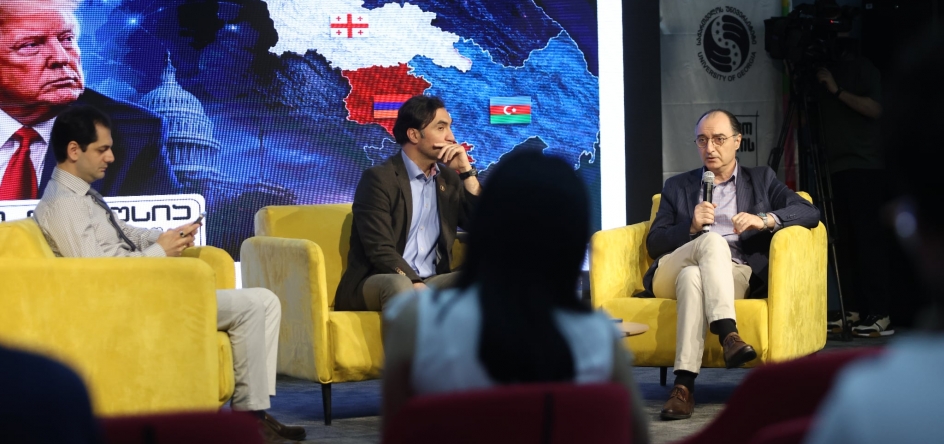
On July 8, the Georgian University Security, Policy and Nationalism Research Center (UGSPN) hosted a public discussion titled "President Trump's Foreign Policy and Its Impact on the South Caucasus."
The discussion focused on the potential shifts in the Trump administration's foreign policy priorities and their implications for the political, security, and economic dynamics of the South Caucasus. Particular attention was given to the growing role of the United States in the region, including Washington's engagement in the Armenia–Azerbaijan normalization process, the strategic significance of the Trump Route for International Peace and Prosperity (TRIPP) initiative, and the broader impact of these developments on Georgia's strategic environment.
The discussion addressed the following key topics:
The invited speakers, Giorgi Labadze and Giorgi Badridze, provided an in-depth analysis of U.S. foreign policy and discussed the potential changes it could bring for Georgia as a key strategic actor in the South Caucasus.
"It is important to understand that President Trump's policy is based on a purely transactional approach, emphasizing the broad allocation of resources and measurable returns. Simply put, we must clearly define what we, as a state, can offer as a foundation for future cooperation," said Giorgi Labadze, founder of the Georgian-American Alliance for Freedom.
Moderated by Shalva Dzebisashvili, the discussion also explored the region's evolving political challenges and the current geopolitical landscape of the South Caucasus, highlighting Georgia's potential to emerge as a leading regional actor.