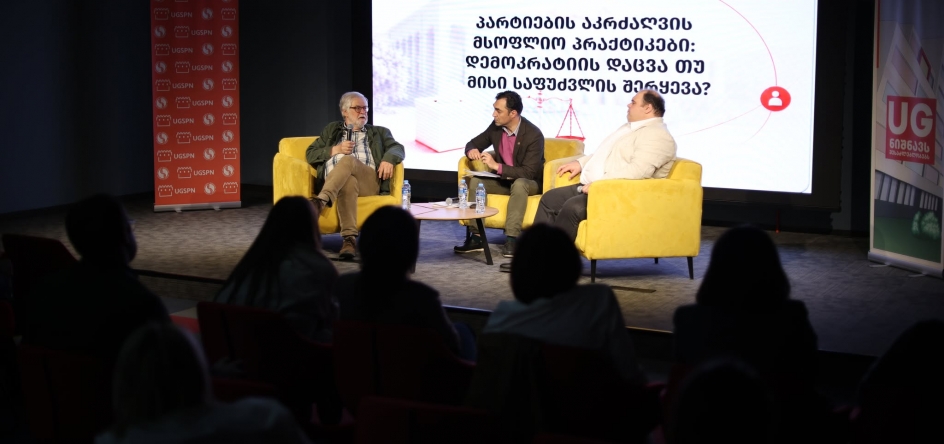
On April 28, at the University of Georgia, a public discussion was held organized by the University of Georgia Center for Security, Politics and Nationalism (UGSPN) on the topic: “Global Practices of Banning Political Parties: Protecting Democracy or Undermining Its Foundations?”
The discussion addressed the recently announced issue of banning political parties, examining international examples and practices. Invited speakers — Kakhi Samkharadze, Head of the Human Rights and Fundamental Freedoms Seminar, and Gia Nodia, Professor at Ilia State University — evaluated both international and local contexts and experiences surrounding the issue. Participants discussed whether banning political parties can be justified under the argument of protecting democracy and what risks such practices may entail.
“Banning political parties, in general, is unacceptable, as it constitutes a severe violation of political rights. The precedents we discussed were motivated by the protection of democracy; however, ongoing processes in Georgia, in my assessment, point toward political collapse. For a small country, it is particularly difficult to form and develop new political forces, and their removal from the political field automatically leads to a monopolized space,” noted Gia Nodia, Professor at Ilia State University.
It is noteworthy that the discussion addressed three main questions. In addition to the issue of banning political parties, the conversation also focused on:
The balance between protecting democracy and maintaining political pluralism, with particular emphasis on the role of political parties and citizens’ freedom of choice;
Assessments related to Georgia, including recommendations issued within the framework of the Moscow Mechanism, and the extent to which ongoing processes align with these standards.
“First of all, I would like to express my sincere gratitude to UGSPN for raising interest in this topic and for creating a platform for discussion, as all the issues we examined carry practical significance for the country’s development. On the one hand, they show the potential consequences of such approaches, and on the other, they help us understand which international experiences can be replicated or where we, as voters, should adjust our expectations,” stated Kakhi Samkharadze, Professor at Tbilisi State University and Head of the Human Rights and Fundamental Freedoms Seminar.
The public discussion provided participants with an opportunity to deeply analyze the link between the protection of democracy and political freedoms. UGSPN continues its tradition of organizing engaging and topical discussions on political as well as social issues for the wider public.